The Submariner, or how Rolex invented a category
Before the 6204, you dove with a watch in spite of itself, not because of it. The story of the reference that created the dive watch as a genre.
By Adrien Vasseur · · 6 min read
© Antigravity AI
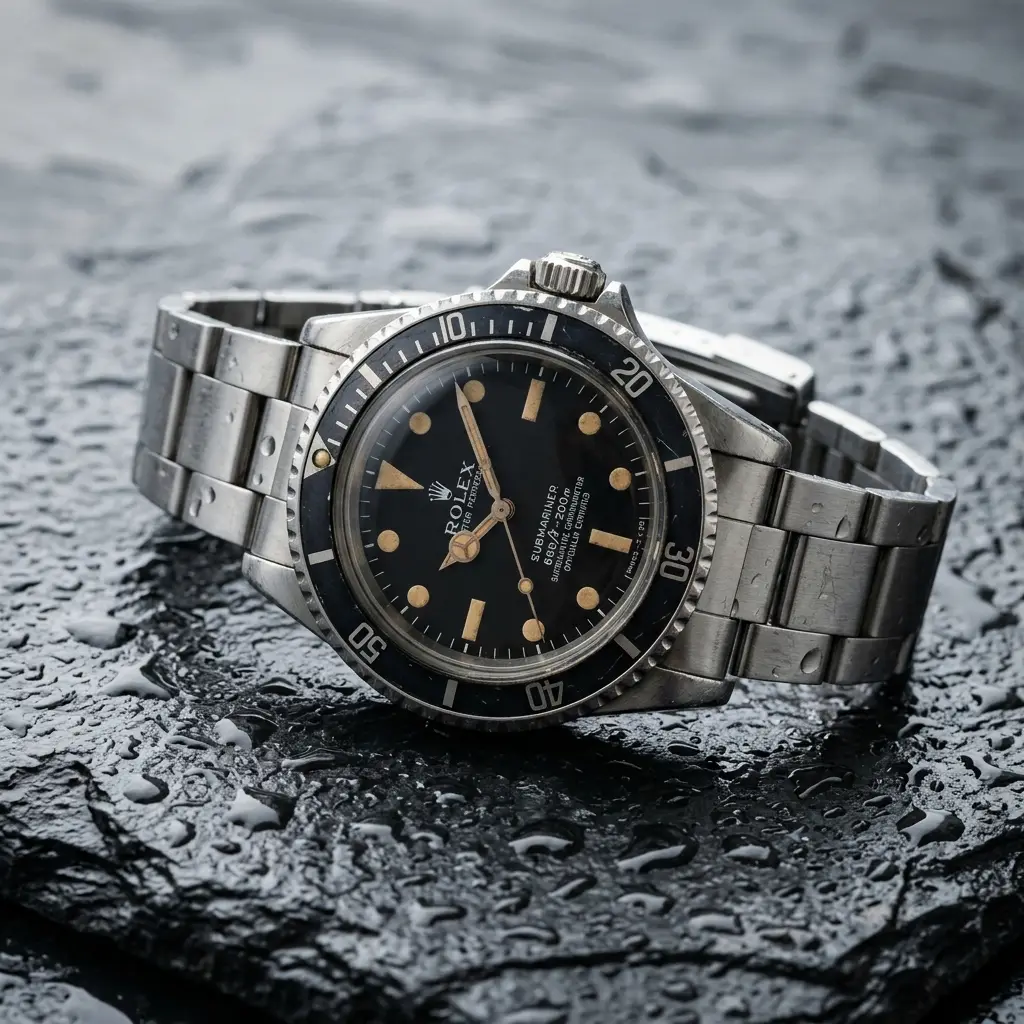
In 1953, Rolex was not making a watch. The brand was defining, without quite knowing it yet, an entire category that did not exist. Reference 6204, the first model stamped Submariner, left the Geneva workshops with a 38-millimetre steel case, a rotating bezel, and the promise, engraved more than spoken, to hold one hundred metres beneath the surface.
The launch price came in an envelope: one hundred and fifty dollars. Today, a 6204 in original condition trades around one hundred and seventeen thousand, carried by a vintage market that keeps re-pricing the earliest references. Time has done its work, but it is use, above all, that built the legend.
The 6538, the Big Crown, and a certain agent
History more often remembers the 6538 than the 6204. It is this one, with its oversized eight-millimetre crown, its calibre 1030 and its water resistance raised to two hundred metres, that Sean Connery wears in Dr. No in 1962. The bracelet, too short for the actor’s wrist (a nylon strap improvised at the last minute), would eventually come to be called the “Bond strap”. No one at the time imagined that a set-dressing accessory would found an entire subgenre of watch collecting.
Hans Wilsdorf was not thinking about cinema. He wanted, he said, “a watch that even a professional diver could take seriously”. A modest ambition on paper, an immoderate one in execution.
Wilsdorf wanted a watch that even a professional diver could take seriously. Seven decades later, it is the benchmark of the category.
A lineage, not a model
From the 6204 to today’s 124060, the Submariner has never undergone a rupture, only a succession of millimetric adjustments. The date in 1969 with the 1680. Calibre 3135 in 1988, whose accuracy redefined the standard, at a time when mechanical watchmaking was only just recovering from the industrial shock that came from Japan. The Cerachrom ceramic bezel in 2010. The move to forty-one millimetres in 2020, with calibre 3235 and its seventy-hour reserve.
Seven decades, seven inflection points. That is what separates an icon from a fashion: the ability to evolve without disowning itself. It is also what makes it, for many, the watch you aim for after your first steps in mechanical watchmaking. The Submariner of 2026 still resembles that of 1953: a little wider, a little more accurate, infinitely more durable. But the gesture is the same: turn a bezel, read a time, do not think about it.
Also worth reading