Five independent watchmakers to watch in 2026
Voutilainen, Rexhepi, Petermann-Bédat, MB&F, F.P. Journe: a tour of the workshops where, movement by movement, the future of horology is being written.
By Hélène Cardon · · 7 min read
© Antigravity AI
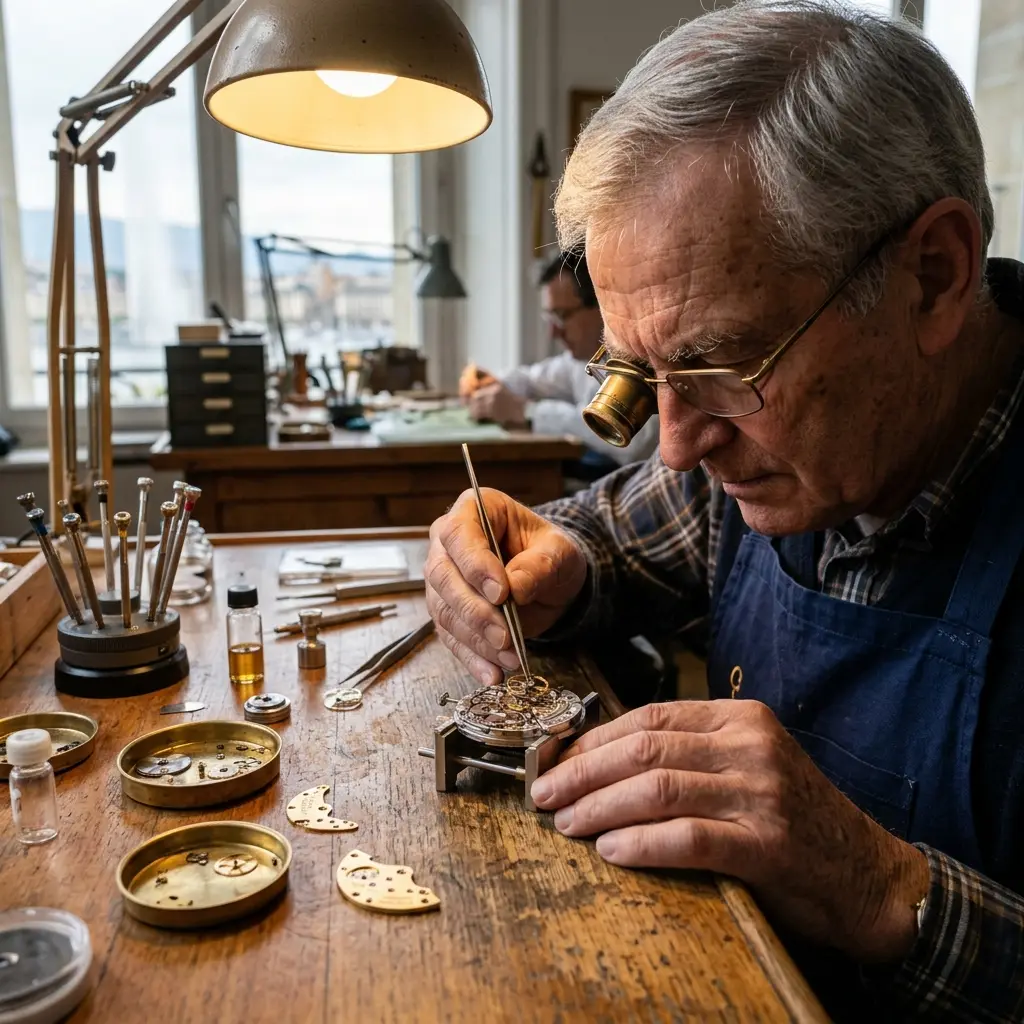
The big horological groups have spent the last decade telling a story of scale: vertical integration, in-house production, scarcity management. Meanwhile, in workshops of a few square metres scattered between Geneva, Renens, Môtiers and the Zurich suburbs, a handful of watchmakers have taken the opposite bet.
Rexhep Rexhepi, the apprentice who surpassed his masters
Founded in 2012 in Geneva, Akrivia is the maison of Rexhep Rexhepi, a former apprentice at Patek Philippe and F.P. Journe. His Chronomètre Contemporain II has generated years-long waiting lists, and each delivered piece is, almost mechanically, resold at twice the price on the secondary market. This is not speculation: it is the collective admission that he builds better than anything any major maison currently produces at comparable prices.
Kari Voutilainen, finishing as religion
Based in Môtiers, in the Neuchâtel canton, Kari Voutilainen practises horology of another era. Hand-guilloché dials, anglage drawn with a polished button, calibres designed in the spirit of the great nineteenth-century manufactures: the Vingt-8 being the best-known example. The absolute reference for what “handmade” means in haute horlogerie.
Petermann-Bédat, the new Swiss generation
Gaël Petermann and Florian Bédat met at the Geneva school of watchmaking in 2007. Now based in Renens, they caused a stir with their 1967 Dead-Beat Seconds: a mechanical dead-beat seconds of disarming elegance, at a price that remains, for a few more months perhaps, accessible to serious but not wealthy collectors.
I don’t make watches. I create kinetic sculptures that tell the time. Maximilian Büsser, MB&F
MB&F and F.P. Journe, pioneers still ahead
Maximilian Büsser, after stints at Jaeger-LeCoultre and Harry Winston, founded MB&F in 2005. His Horological Machines and Legacy Machines created a category of their own: kinetic sculpture.
François-Paul Journe has nothing left to prove. Based in Switzerland since 1989, with his “Invenit et Fecit” engraved on his calibres like a challenge to convention, he continues to produce (only a few hundred units a year) pieces like the Souveraine and the Chronomètre à Résonance that 2026 auctions have confirmed as safe-haven values.
A bubble that is rationalising
Phillips and Sotheby’s auctions over the past year tell a two-part story: unique pieces and truly limited series from the five names above continue to climb, while wider editions are seeing a healthy correction. The market now distinguishes craftsmanship from production. Probably the best news for these workshops in ten years.
Also worth reading